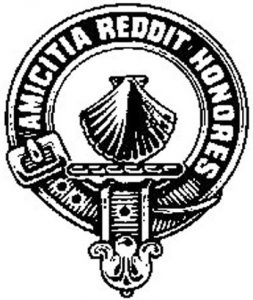
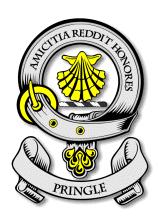
The Clan Pringle Crest Badge on a Gala Water Tartan backing.
The Clan Pringle Crest Badge for non-armigerous members of a clan.
The Clan Pringle Crest Badge
In Scots law a coat of arms is the personal property of the person to whom it was granted to, and there is no such thing a clan or family coat of arms. This was so an individual knight could be identified on a battlefield. It is illegal in Scotland for someone to appropriate and use a coat of arms belonging to another or to use a fake unofficial coat of arms, one needs to be granted the use of a coat of arms by the Court of the Lord Lyon, the King of Arms in Scotland. Anyone who appropriates another’s coat of arms or adopts a fake unofficial coat of arms is a charlatan with no honour. It is traditional for ordinary non-armigerous members of a clan to wear the clan chiefs crest badge in a belt and buckle with the chiefs motto upon it, as a symbol of their allegiance to the clan chief.Further reference:
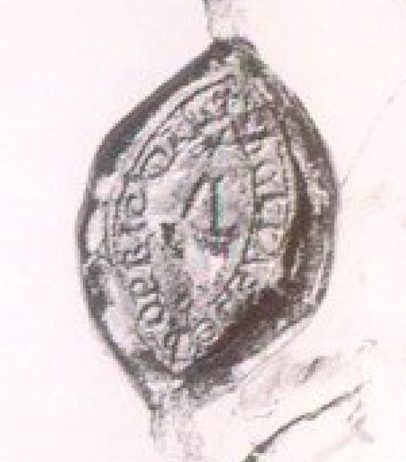
The earliest Pringle to use a heraldic device was Elias De Hoppringill [Elys de Obrinkel in the text] (Tenant of the bishop of St Andrews), who in 1296 attached his seal to the Ragman Roll. It was described “Oval, a hunting horn. S. [Sigillum] Helias de Hoppri’gkill.” – Source: Ragman Rolls, page 147 and in the Calendar of Documents, page 205 and seal page 544.
The Seal of Elias de Hoppringill from the 1296 Ragman Rolls, described "Oval, a hunting horn. S. [Sigillum] Helias de Hoppri’gkill."
After the Scottish War of Independence was won by King Robert the Bruce, he sent his friend and lieutenant, the ‘Good’ Sir James Douglas (also known as the ‘Black Douglas’) to bury his heart in Jerusalem, as the King had long wished to go on Crusade but had been unable. Sir James died fighting the Moors in Spain at the battle of Teba, whilst on his way to Jerusalem, the long way round. The Pringles were the squires and men-at-arms to the Douglases, and would have accompanied Sir James to the pilgrim site of Saint James of Compostela in northern Spain. However, only the knights were named, so it is impossible to be sure. The Black Douglas held the title of ‘Lord of the Forest’ i.e. the Selkirkshire Forest and the men of the Pringle surname were always counted as among the men of the Selkirkshire Forest. It is believed that ever since this time the Pringles have used the badge of St James (a scallop shell) as their principal heraldic device.The chiefs of the clan, the Hoppringles of that ilk traditionally used three golden scallop shells on a black bend (a diagonal stripe), all upon a white/silver shield. This can be seen on the seal of Thomas Hoppringill of that Ilk, who’s seal dating from 1555 is described as “On the shield a bend charged with 3 escallops, legend round the circumference ‘S. Thome Hoppryngill.’ (Cosmo Innes Transcripts).
An AI representation of the Seal of Archibaldi de Pringil in 1461
Archibald Hoppringill, second son of Pringle of that ilk (1461) Seal described as: On a bend two escallops, legend, ‘S. Archibaldi de Pringil’. (page 10) – MacDonald’s Scottish Seals.
An AI representation of the Seal of Jacobi Hoppringill in Newbattle in 1530
James Hoppringill in Newbattle (1530) Seal described as: On a bend 3 escallops with a stags head couped in chief; legend, ‘S. Jacobi Hoppringill’. (page 34) – MacDonald’s Scottish Seals.
An AI representation of the Seal of Thome Hoppryngill of that ilk in 1555
Thomas Hoppringill of that Ilk and Torsonce (1555) Seal described as: On the shield a bend charged with 3 escallops, legend round the circumference ‘S. Thome Hoppryngill’. (page 16) – Cosmo Innes Transcripts.
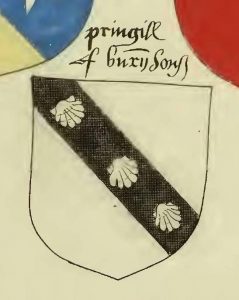
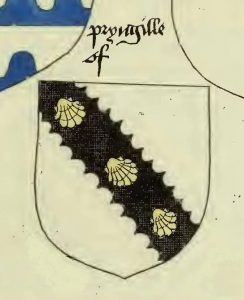
The earliest cadet branch, the Hoppringles of Smailholm differenced these arms by having an engrailed bend. This can be seen in Sir David Lindsay of the Mount’s Armorial of 1542 (who was the Lord Lyon at that time) which shows both the Arms of Pringle of Burnhouse and of that Ilk and Pringle of Smailholm (see pictures below). The Armorials of Sir Robert Forman of Luthrie (another Lord Lyon) that date from 1563-65, also show the Arms of Pringle of Burnhouse.
The Arms of Pringle of Burnhouse (that Ilk) in 1542
The Arms of Pringle of [Smailholm] in 1542
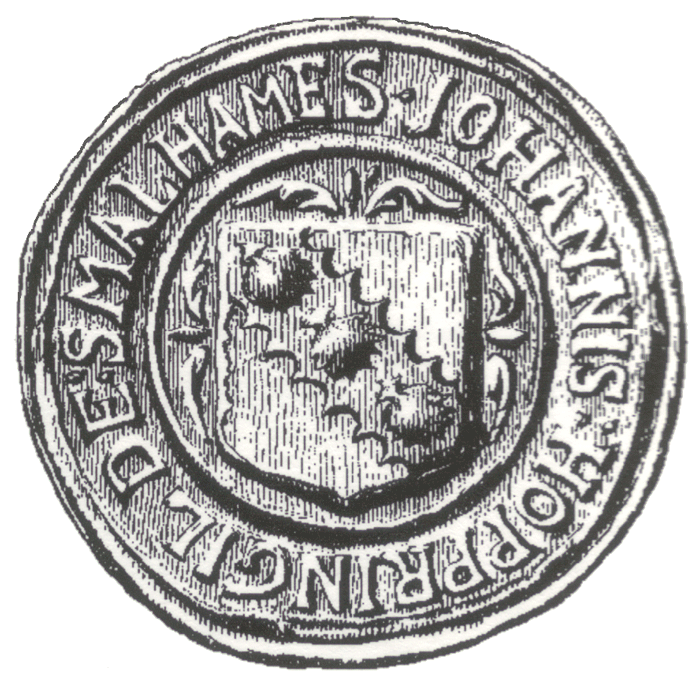
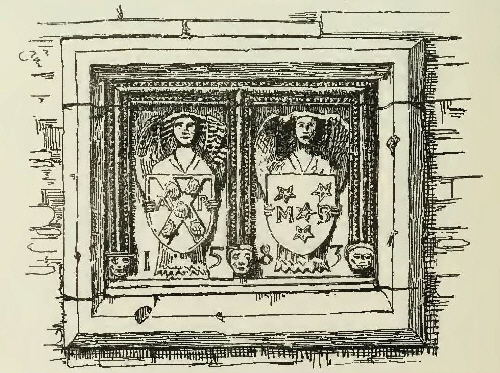
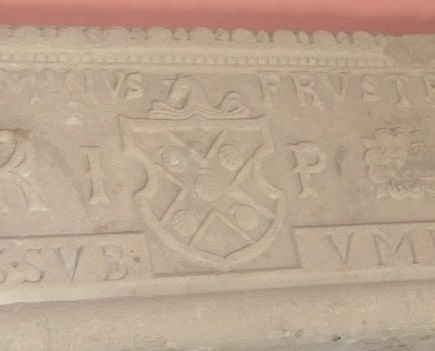
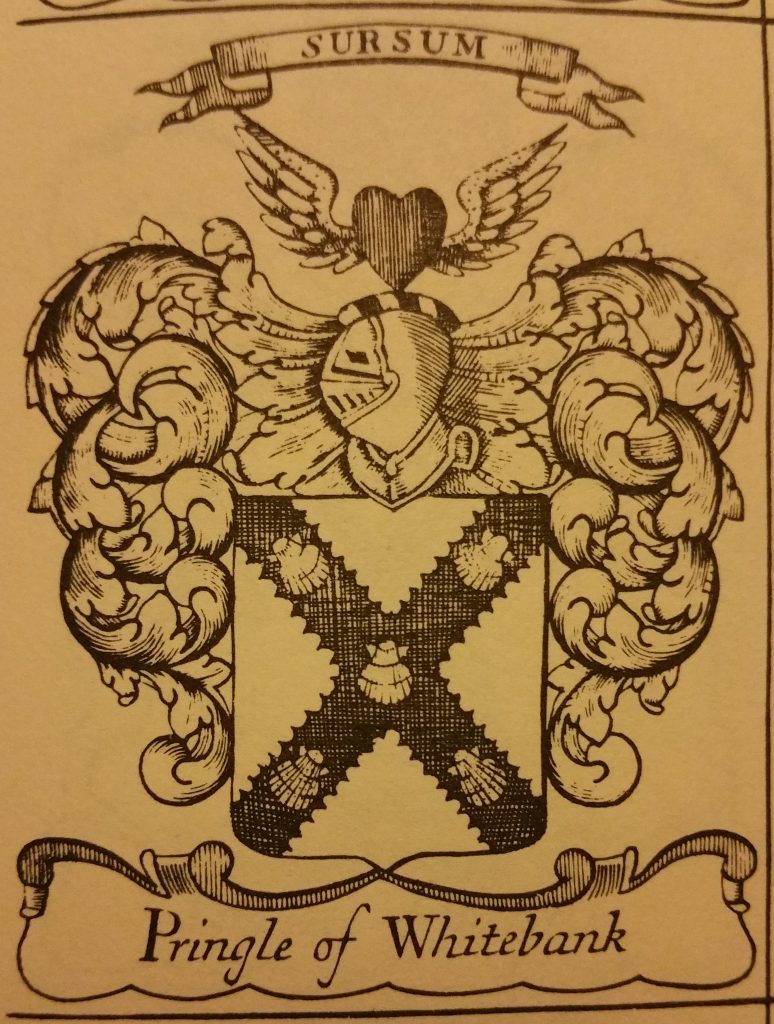
The 1537 Seal of John Hoppringill of Smailholm and Gala, the 5th Laird (picture below from Laings Seals) also shows an engrailed bend. Howeever, in 1583, his son Andrew Pringle of Smailholm and Gala, the 6th Laird, had his arms carved on a stone block above the door of his new residence (what is now called ‘Old Gala House’) and these arms show five scallop shells upon a saltier (St Andrews Cross). His son Sir James Pringle of Gala, the 7th Laird, built an extension to the house in 1611 and had another panel or fire place lintel carved with the same arms (with what appears to be an addition of a Unicorns head for a crest), which can still be seen in the house. The reason why the Pringles of Smailholm changed their arms from three scallop shells on an engrailed bend to five scallop shells on an engrailed saltier, is not recorded. These arms were later matriculated in the Lyon Register by the Pringles of Whytbank as representors of the Pringles of Smailholm and Gala.
The 1537 Seal of John Hoppringill of Smailholm and Gala, the 5th Laird.
The 1583 Arms of Andrew Pringle of Smailholm and Gala, 6th Laird, on the wall of his house, Old Gala House.
The 1611 fireplace lintel from Old Gala House, with the Arms of Sir James Pringle of Smailholm and Gala, 7th Laird.
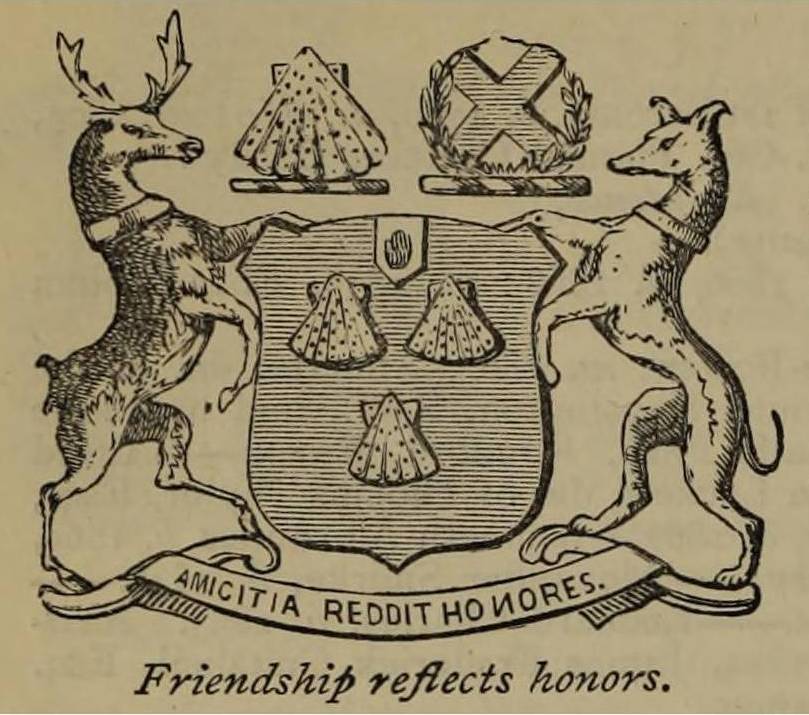
The Forman-Workman’s Armorial Manuscript (Lyon Office, compiled about 1565-66) has the Pringle of Burnhouse Arms illustrated with a Buck and a Greyhound as supporters (and a horses head as a crest). This is because when William Hoppringle of that ilk died in 1458, he had no sons, so his nephew Adam Hoppringle of Burnhouse (died in 1494), who was a Royal Guardsman of King James III of Scots, became the next Hoppringle of that ilk and head or chief of the name.
An AI representation of the Arms of Pringle of Burnhouse, as the original pen and ink drawing is copyright to the Lyon Office.
Buckholm Tower used to bear a stone panel dated 1582 (it’s now in Torwoodlee House) carved with the initials of John Pringle of Buckholm and his wife. He was the grandson of James Hoppringle of Tynnes who acquired the lands of Buckholm after a historic act of bravery in 1524, when he saved the live of King James V of Scots. This James Hoppringle’s father was David (senior) Hoppringill of Tynnes, Ranger of the Selkirkshire Forest, who was the illegitimate son of James Hoppringill, the third Laird of Smailholm and Gala. The shield bears three escallops on a bend sinister, with a hunting horn in the dexter chief. In heraldry the bend sinister traditionally represents illegitimacy.
The Arms of John Pringle of Buckholm in 1582
In 1672 the Scots Parliament passed a law requiring armigerous individuals to register their Arms within a year. In 1673 the Pringles of Stitchell, Greenknowe, Whytbank and Torwoodlee all duly registered their arms in the Public Register of the Lord Lyon. None of these four branches of the clan matriculated supporters to their arms. George Hoppringle of Torsonce (and that ilk) was a soldier and was away with the army so did not matriculate his coat of arms.
Arms of Robert Pringle of Stichill
Arms of James Pringle of Greenknowe
Arms of Alexander Pringle of Whytbank
Arms of George Pringle of Torwoodlee
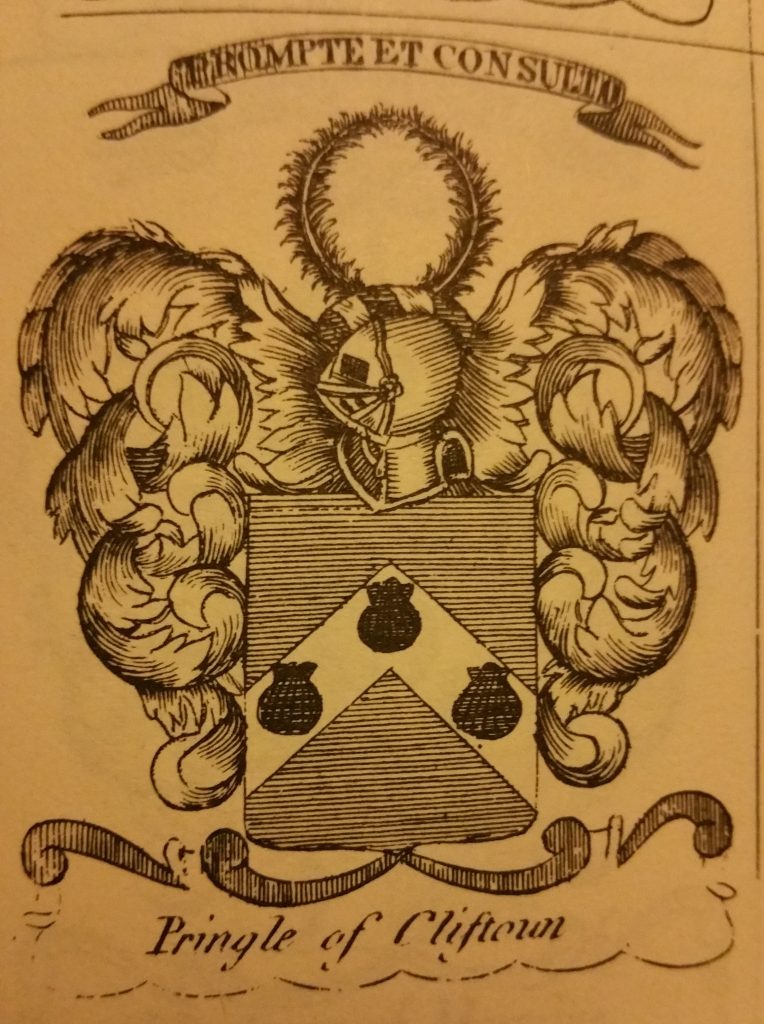
In 1693 Andrew Pringle of Clifton was granted Arms and they were recorded in the Lyon Register. So were the Arms of John Pringle, Lord Haining in 1731 and also the Arms of Sir Walter Pringle, Lord Newhall in 1733. Then the Arms of Mark Pringle of Crichton in 1743.
Arms of Andrew Pringle of Clifton
John Pringle, Lord Haining
Sir Walter Pringle, Lord Newhall
Mark Pringle of Crichton
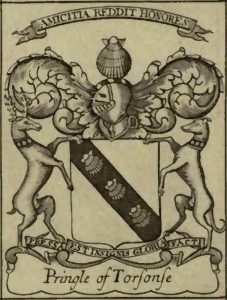
In 1722 Alexander Nisbet published his book ‘A System of Heraldry’ and he included the arms of the Pringles. He describes and illustrates the arms of Hoppringle of that ilk (as chiefs of the clan or heads of the name) as having supporters, a deer on the right and a greyhound on the left. His description and illustration of the arms of Stitchell and Whytbank do not include supporters.John Hoppringle of that ilk (and Torsonce) died in 1737 without a male heir. His daughter had married Gilbert, a younger son of Pringle of Stitchell, after their deaths the lands passed into the Pringle of Stitchell family.
The Arms of John Hoppringle of that ilk (and Torsonce), who died in 1737 - from Nisbet's System of Heraldry.
The Arms of John Hoppringle of that ilk (now the personal property of Sir Murray Pringle, 10th Bt.)
Nisbet also illustrated these arms:
In 1793,John Pringleof Lyme Park (1755–1824) became High Sheriff of Armagh and according to Burkes General Armory was granted a Coat of Arms by Ulster King of Arms:
Pringle of Caledon, co. Tyrone, Ireland: Granted by Betham, Ulster, to JOHN PRINGLE, Esq., of that place, Deputy Governor of cos. Armagh and Tyrone. Arms: Ermine on a bend sable three escallops erminois. Crest: An escallop, as in the arms. Motto: Amicitia reddit honores.(These arms are a differenced version of the arms of Pringle of that ilk and Torsonce, implying that they descend from that family.)
John Pringle of Caledon, co. Tyrone, Ireland
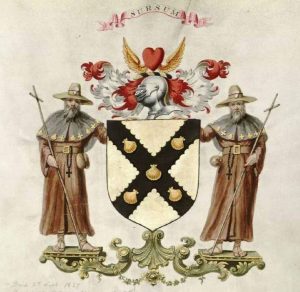
In 1828 the Lord Lyon granted Alexander Pringle of Whytbank, as the representative of the Pringles of Smailholm and Gala, two Pilgrims as supporters. The Lord Lyon must have assumed that the Whytbank Pringles were now the heads of the name, since it has long been assumed that the Pringles of Stitchell were a cadet branch of the Smailholm Pringles. This is not the case, the Pringles of Stichell are cadets of the Pringles of that ilk.
The Arms of Alexander Pringle of Whytbank - from the Lyon Register
The Arms of Alexander Pringle of Whytbank
John Burke in 1844 recorded in his ‘Encyclopaedia of Heraldry’ that the Pringles of Stichell bore two greyhounds as supporters (a clear error in by Burke), along with the crest of Pringle of that ilk and their own crest. The 1864 version of Debretts shows the Pringles of Stitchell as bearing a buck and a greyhound as supporters, along with the double crests of that ilk and their own. The Pringles of Stitchell continued to use the crest and supporters of the Pringles of that ilk in correspondence at least until 1919. The last Pringle laird of Whytbank died in 2003, ending the rivalry between the Pringles of that ilk (and their cadets the Pringles of Stitchell) and the Pringles of Smailholm (and their representatives the Pringles of Whytbank).According to the laws of Scottish heraldry only clan chiefs and nobles are entitled to use supporters.
This drawing from Burkes has two greyhounds by mistake.
The new matriculation of arms
by Sir Norman Murray Pringle of that ilk
10th Baronet of Stichill:
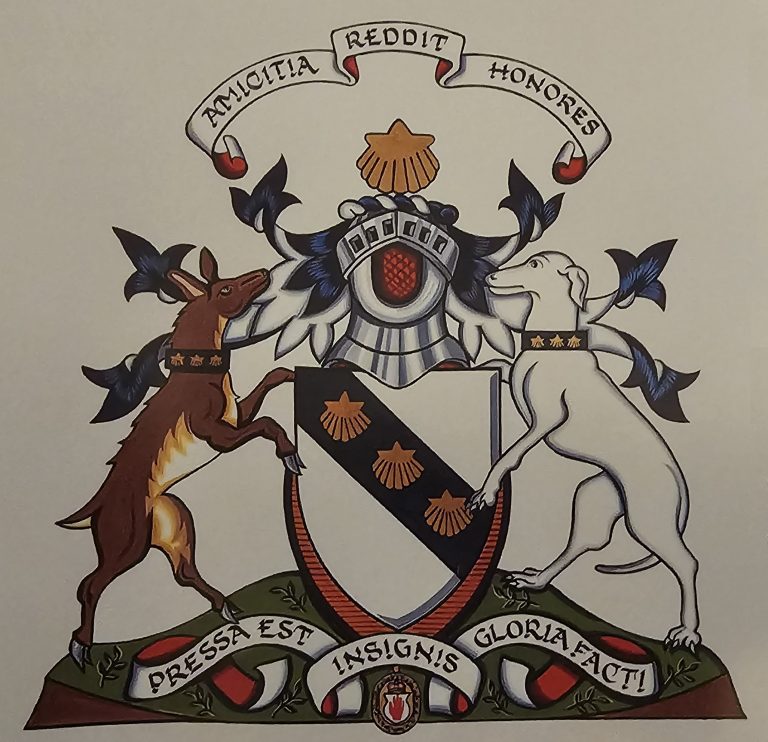
In 2020 the Lord Lyon found that Sir Murray Pringle of Stichill is the rightful clan chief, who is entitled to bear the undifferenced arms of the house of Pringle with supporters, a new version of the arms of Pringle of that Ilk and Stitchill was matriculated in the Lyon Register. See Lord Lyons decision: Lord Lyon’s Pringle Findings and Reasons 18th February 2020 and Interlocutor from the Lord Lyon 28th May 2020.
Ensigns Armorial: Argent, on a bend Sable, three Escallops, Or; Above the Shield, which is environed of the badge pendent by its proper ribband of a Baronet of Nova Scotia, is placed an Helm befitting his degree with a mantling Sable doubled Argent, and a Wreath of the Liveries is set for Crest an Escallop as the former, and in an Escrol over the same this motto “AMICITIA REDDIT HONORES”. On a compartment semee sprigs of elder leaves bearing the words “PRESSA EST INSIGNIS GLORIA FACTI” are set for Supporters dexter a deer proper, and sinister a Grey-Hound Argent and collared Sable charged with Escallops Or,
Sir Murray Pringle of that ilk's coat of arms as chief of the clan (with the wrong baronets badge, it should have a Nova Scotia Baronets badge. The stags antlers are also missing)
The Arms of Sir Murray Pringle, 10th Bt. (it should have a knights helmet facing the front with an open visor, not a side facing gentleman's helmet. Also a Nova Scotia Baronets badge suspended from an orange ribbon below the shield)
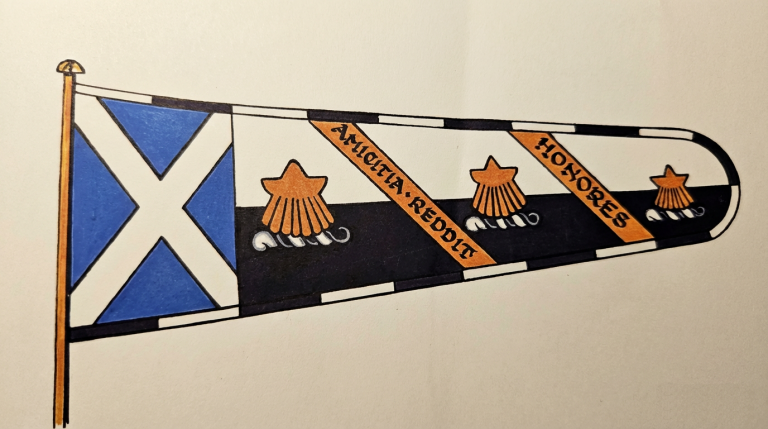
Standard: and upon a standard of four and a half yards in length parted in two Argent and Sable with the St Andrew’s Cross in the hoist is depicted the Petitioner’s said Crest three times in the fly with the motto “AMICITIA REDDIT HONORES” in Sable upon the transverse bands Or;
Sir Murray Pringle's Standard
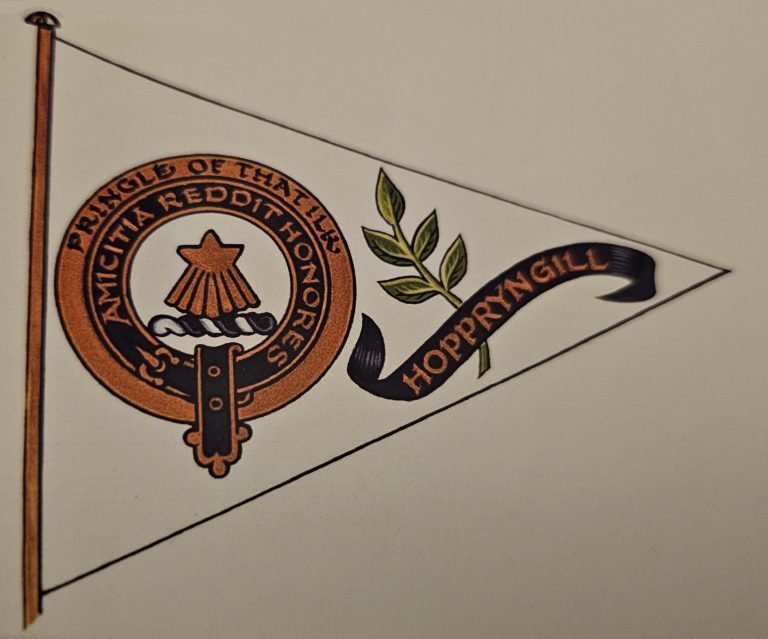
Pinsel: and for Pinsel, four and a half feet long by two feet in height, Argent, upon a Wreath of Liveries Argent and Sable, bearing the Petitioner’s said Crest within a strap Sable buckled and embellished Or, inscribed with the motto “AMICITIA REDDIT HONORES” Or, all within a circlet Or bearing the Petitioner’s title “Pringle of that Ilk” Sable and in the fly an Escrol Sable bearing the slogan “Hoppryngill” Or with the clan plant badge a sprig of elder leaves.
Sir Murray Pringle's Pinsel
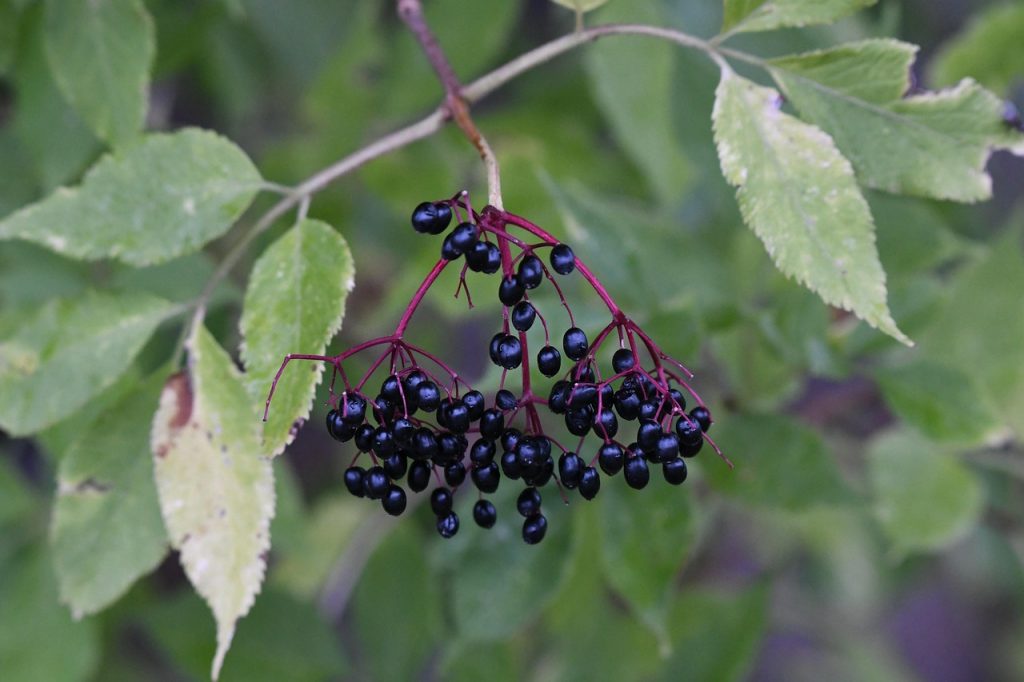
Elderberry and leaves
Elderflower and leaves
The Clan Pringle plant badge: a sprig of Elder leaves (Sambucus Nigra).
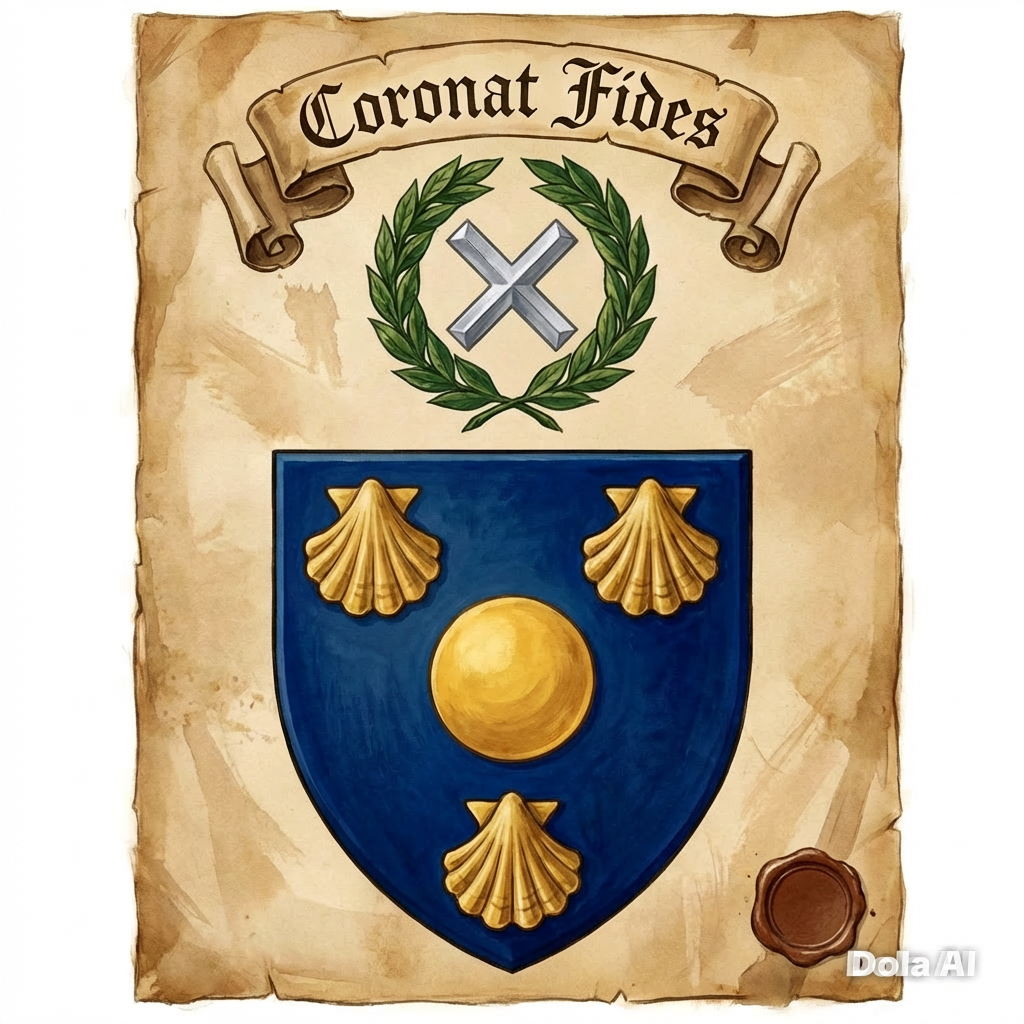
The Lord Lyon King of Arms also recognised separately, that Sir Murray Pringle was entitled to the Name and Arms of Pringle of Stichill and that the said ensigns armorial of Pringle of Stichill as recorded in Volume 1 of the Public Register of All Arms and Bearings in Scotland. Which were:
Robert Pringle of Stitchell (12 Sep 1673), Vol. I. p. 203. Bears azure three Escalops Or, above the shield a helmet befitting his degree, mantle glues doubled argent. Next is placed on an torse for his crest, a St Andrews cross within a Garland of bay leaves proper. The motto is an Escroll, Coronat Fides.
Sir Murray Pringle's coat of arms as the 10th baronet of Stichill (with incorrectly coloured mantling)
Sir Murray Pringle's coat of arms as the 10th baronet of Stichill (with correctly coloured mantling)